SDD describes the change, not the product
SDD tools mix product and implementation in one place. PDD draws the line and gives the product a model of its own.

Spec-driven development works. If you use OpenSpec, spec-kit or Kiro, you know the shape: describe the change before you build it, plan it, break it into tasks, and let the agent work against a written target instead of one sentence in a chat. This post is not an argument against it. It is about where it falls short, and what it does not cover properly: the product.
What these tools keep
None of them throws the work away when it ships.
- OpenSpec keeps
openspec/specs/as the source of truth for how the system behaves today. Each change carries a proposal, a design, tasks, and delta specs. Archiving merges the deltas into the main specs and files the rest underchanges/archive/. - spec-kit gives each feature its own directory with
spec.md,plan.mdandtasks.md, plus a project constitution. Whether those files stay living or become history is left to each team. - Kiro writes
requirements.md,design.mdandtasks.mdfor each feature, and keepsproduct.md,tech.mdandstructure.mdas steering files that every conversation reads.
So the files stay. The question is what they hold.
The product gets mixed with the build
What usually steers these frameworks is the technical side: the design, the plan and the tasks. The product requirements are rarely discussed in full, and what is covered ends up mixed into the technical artifacts the framework produces.
And the product never sits in one place. It is spread across feature and change folders, so nothing describes the whole of it.
That matters. When the two are mixed, you can no longer tell what the product must do from how it happens to be built today.
The specs drift
A spec is only as true as the last time someone updated it. A hotfix, a refactor, a change made outside the workflow, and it quietly stops matching the code. spec-kit's own docs name the risk: silent divergence.
Keeping them current is a chore nobody owns. Every change means touching the proposal, the design and the specs, and the more files pile up, the more work each change costs. So it gets skipped, and the next agent builds from a spec that is no longer true.
Splitting the product from the implementation changes that. The product lives in one place, so a product decision is written once, not restated in every spec it touches. A purely technical change, like a refactor or a new library, never has to touch it. And that one record serves every change, every agent and every person on the team.
Draw the line
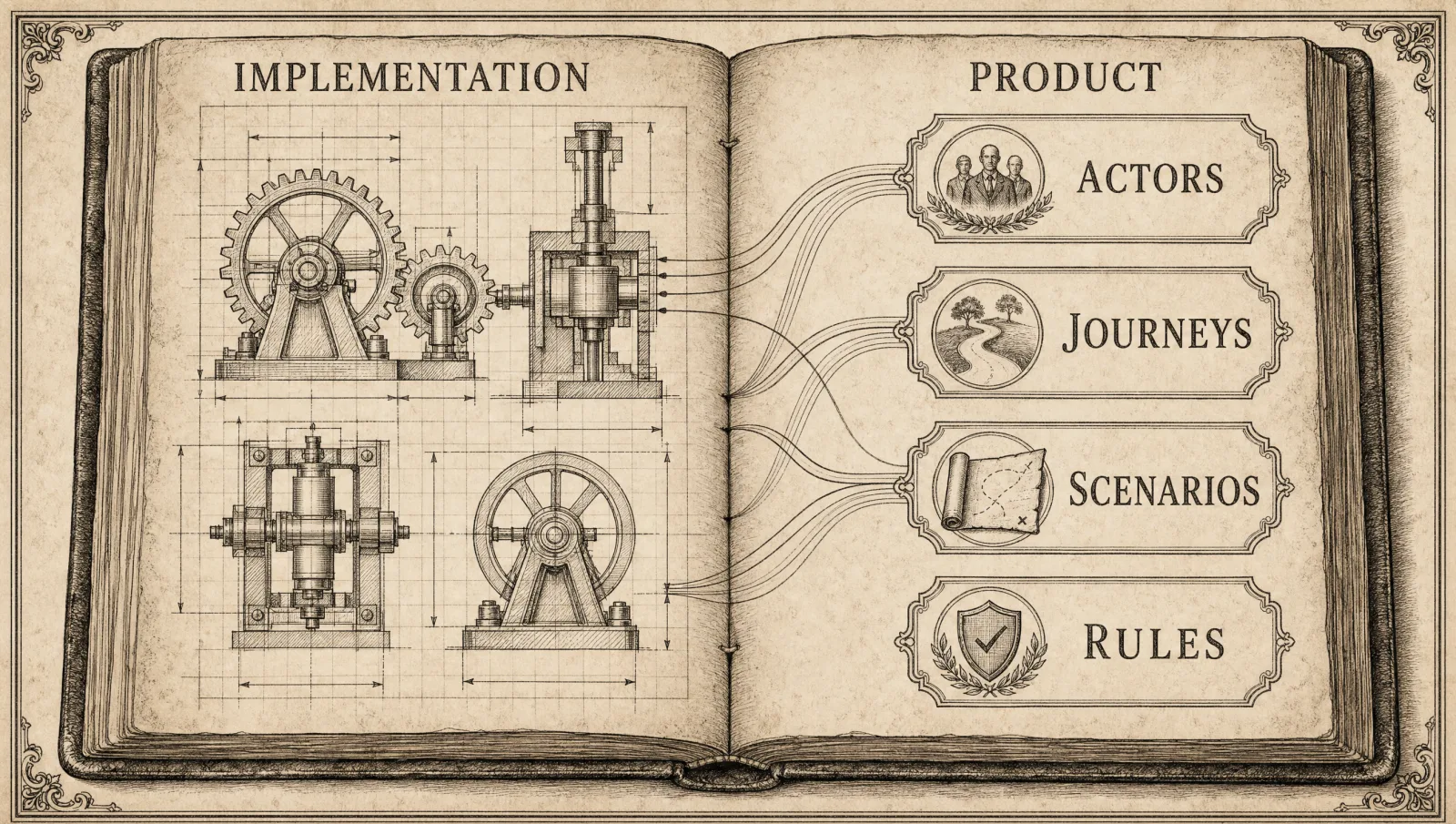
PDD draws the line between product and implementation, in one place. A Product Model holds what any rebuild of the product would have to keep, and nothing a rebuild is free to change:
| In the Product Model | Left to the spec and the code |
|---|---|
| Who can reach each place | Architecture and data flow |
| What it shows and asks for | Components and layout |
| What can be done there | API style, endpoints and tokens |
| Which rules apply | Libraries and frameworks |
| What happens next | Tasks and file changes |
Because it is kept apart, the model can also be checked against the code on every change, so drift shows up when it happens instead of a year later.
SDD describes the change. PDD describes the product.
Spec-driven development is good at what it was built for: planning and building a change. It was never meant to hold the product. Give the product a home of its own, kept apart from the technical artifacts and checked against the code, and your specs can go back to doing what they do best: describing the build.
Nothing else has to move. Keep the spec-driven framework you use, or use none at all. The product just gets a place of its own.
For the problem this comes from, read AI is writing code for products it doesn’t understand.
Give your agent the product, not just the code.
Build a Product Model in your own repository, or pull a Blueprint and hand it straight to a coding agent.