
Introducing pdd-kit: PDD for coding agents
PDD gives agents and humans a shared product model that is git-tracked, reviewable, and verifiable. Open source and MIT licensed.
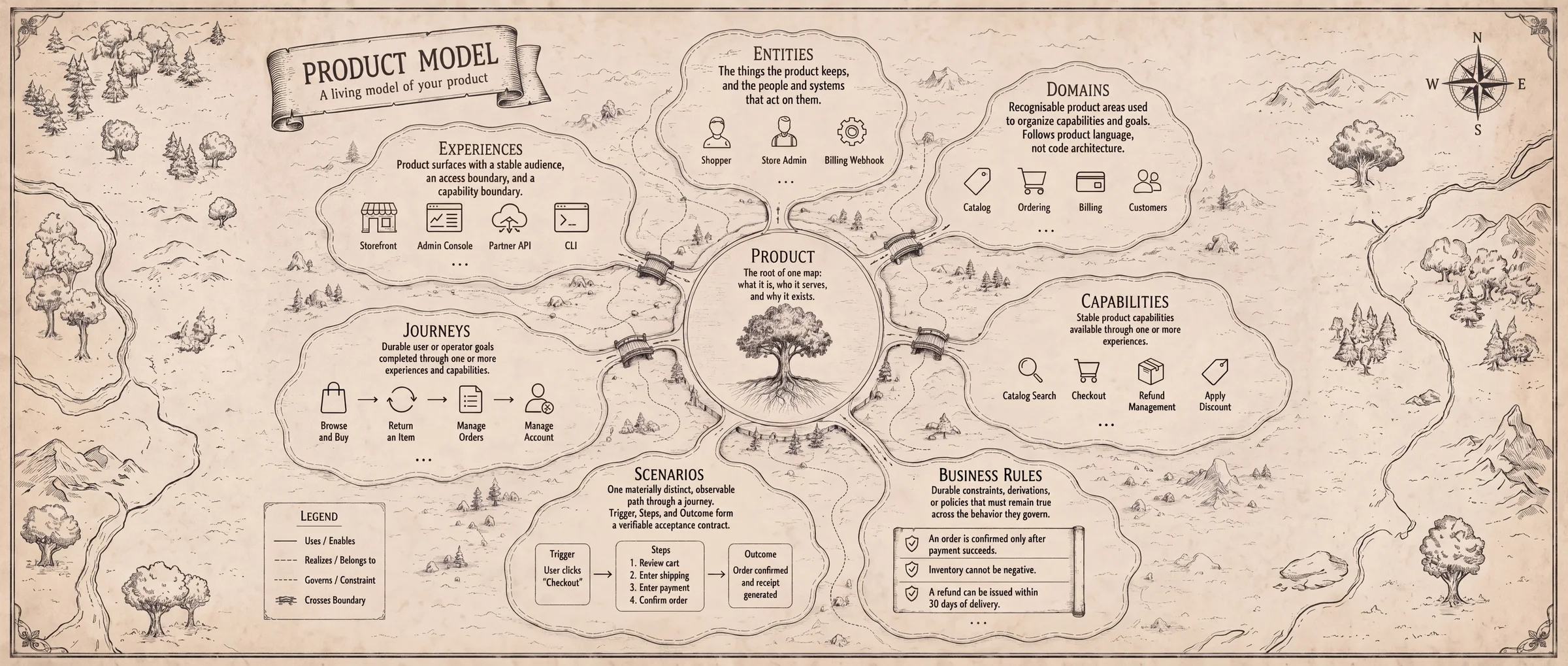

Coding agents write code faster than anyone can explain to them what the product is. So they guess, and the guesses ship. That problem is laid out in AI is writing code for products it doesn’t understand, and why spec-driven development does not solve it in SDD describes the change, not the product.
Today we are releasing pdd-kit, an open-source implementation of Product-Driven Development (PDD). It gives your agent, and your team, one definition of the product to build from and check against.
What you get
A Product Model. A product-model/ folder of Markdown files that says what
your product does: who it serves, where they reach it, what it keeps, what it
can do, and which rules must stay true. It lives beside the code and changes in
the same pull requests. It defines the product, not the implementation, so
colors, layout and frameworks stay yours to choose.
Three agent skills for Claude Code, Codex, Gemini CLI and more:
mapreads an existing codebase and drafts the model from it.ideatedecides the next change with you and writes only what you approve.verifychecks the code against the model and works through the gaps with you until the two agree, or until something blocks it.
A CLI. pdd-kit lint checks the model's files. pdd-kit view
opens the model as a local report that follows your edits.
Blueprints. Reviewed Product Models of common products in a public catalog. Pull one into an empty directory and hand it to your agent.
Every Blueprint is tested the same way: a fresh agent gets the model and the words "build this", and has to ship a working product.
One loop, run on every change
Ideate
/pdd-ideateDecide the next change and record it in the product model.
Implement
your agent, your way
In phases, with plan mode, an SDD tool, or freestyle.
Verify
/pdd-verifyCheck and improve the code and product model until they agree.
Back to Ideate. The next change starts here.
Ideate and verify with pdd-kit. Your own agent implements, your way.
Get started
npx @itai-gendler/pdd-kit install
Then start from where you are: existing code, an idea, or a Blueprint.
To see a real model first, run npx @itai-gendler/pdd-kit view itai-gendler/pdd-kit.
pdd-kit is developed with pdd-kit, and that command opens its own
Product Model.
It is MIT licensed and local-first: no account, no hosted service, nothing to buy. The skills read your code and never run it.
What comes next
This is an early release, and the open issues are the roadmap:
- More Blueprints across different kinds of product, such as a storefront, a booking app, a project tracker and an API service.
- Review model changes as product changes. A compare mode in the report that shows what a branch changes in the product, not just in the Markdown.
- Products that don’t fit one repository. One product spread across several repositories, and several products in one repository.
- KPIs in the model, so it can say how the product's value is measured.
- GitHub issues linked to the model, so tracked work keeps its product context.
- Talk to your agent from the report, without switching back to the terminal.
Try it on a repository you know well and compare the model it drafts with the one in your head. Where they disagree, and where pdd-kit gets in your way, open an issue. Contributions, Blueprints included, are welcome through pull requests on itai-gendler/pdd-kit.
Give your agent the product, not just the code.
Build a Product Model in your own repository, or pull a Blueprint and hand it straight to a coding agent.